
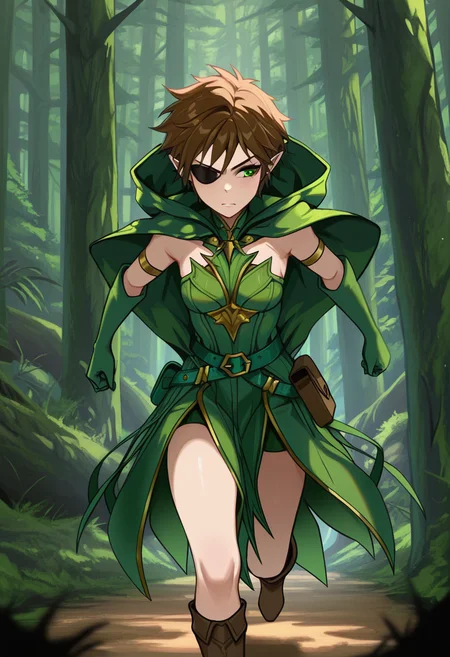
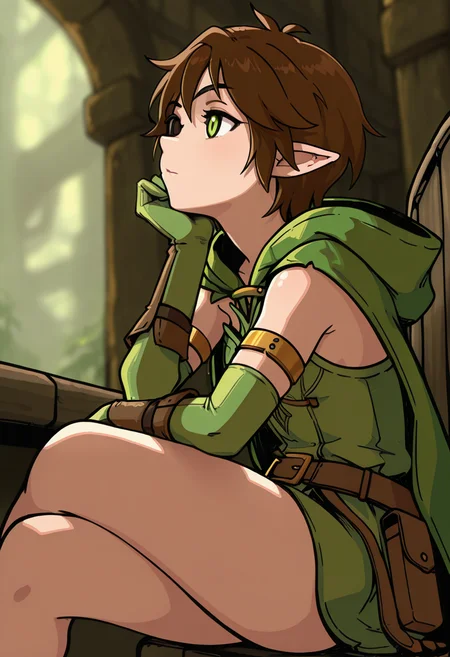
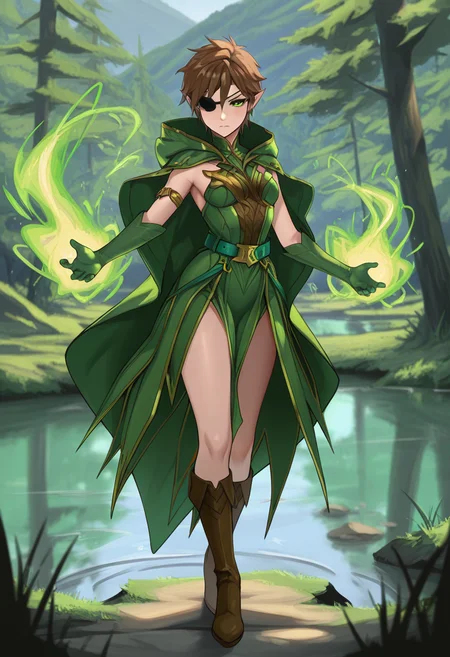
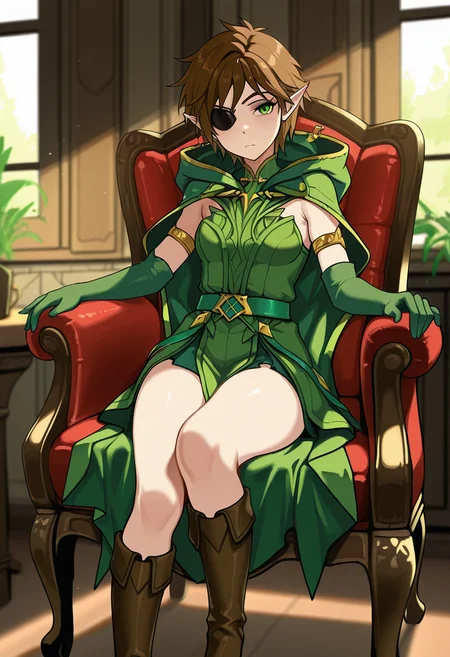
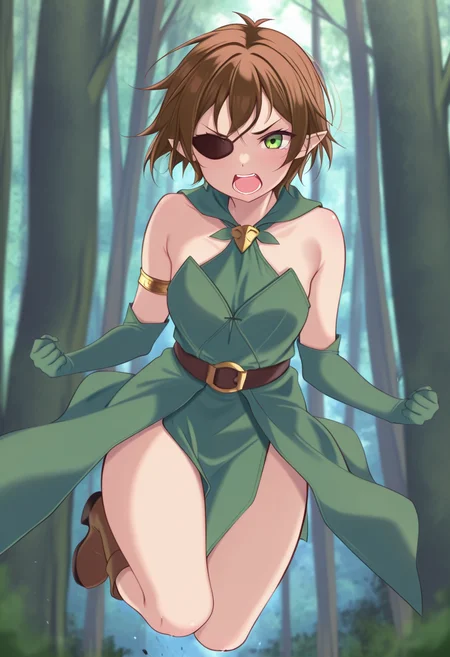

The half-elf planeswalker Freyalise from MTG.
Lore fact: As an "oldwalker" she theoretically could have healed her eye, but either didn't want to or just decided to keep the eyepatch because it looks cool.
Description
Recommended Negative Tags:
print eyepatch, long dress,Comments (11)
How many images did you use for this? I know you experiment with low quantity datasets but curious since she actually has a decent number of images compared to average random MtG characters (especially if you count the comics, though that's probably worth segregating into its own version).
I used 6 images for training this one. Unfortunately most of the official card art for Freyalise is unusable for training imo due to being either too lowres, or being a poor representation of character traits. Some of the oldest art kinda looks like a completely different character (ex. files.mtg.wiki/Pernicious_Deed.jpeg). It was also difficult to find fanart of her, I'm sure a lot of it was lost in old MTG forums :(
I wasn't aware of there being comics though, I may look into those.
@forcekin44 Thanks. Worth noting that, in my experience (which absolutely does not cover realistic stuff), as long as you clear the 256/256 minimum without substanial bits of other characters and aren't jaypegged, you can indeed use "lowres" data. The "depth" that the trainer sees images as is closer to a vector than a human sees it (there's some tools to convert an image to an approximation of one out there). At most you'll lose fidelity of hands (SD1.5 just stuffing its base model with such is why it was so bad there) but those can be fixed with regional stuff if really a problem and will be a problem anyways. My pre-spark Chandra LoRA actually uses a lot of low res stuff to get to its quantity, and a lot of my stuff doesn't use much better (I love making LoRAs for old obscure stuff, including several 480p series and I've even gotten good results off teeny tiny sprites). Main issue is the inconsistencies in the art and not having a good shot of the regulator so it gets read as a pouch.
@NanashiAnon I really appreciate the insight! I'll do some experimenting with more lowres additions and see what comes from it. You've gotten great results with that Chandra LoRA.
I'm with you there, it's fun to dive into more niche characters.
Out of curiosity, what is the dataset size you aim for when making a character LoRA? And does the Clip Skip number actually matter, or is it just a holdover from SD1.5?
@forcekin44 For characters, I've found ~20 to be the threshold that I wouldn't bother if I couldn't exceed for characters. The few times I did go lower the LoRA preformed noticeably worse. I think ~30 is what I'd prefer for a single outfit character, past which one just gets diminishing returns and strong inherent style (though this also depends on the nature of what images are in the data). I don't really have data for outfits/poses/etc. but I think the minimum for them is about the same from what I've seen.
Styles are a different story. Based on what I've seen (both with my work on styles, the "inherent style" that will show up on characters trained on a single work, and the work of other people on stuff with such finite data I can make a good guess on how many images they used even without being explicitly told) they can be divided into two types "narrow" and "general purpose". "Narrow" styles are things that are only expected to make one kind of image (e.g., my Fallout Talking Head Style LoRA is only expected to make character portraits at a relatively limited viewpoint, while my Dawn of Souls Style LoRA is only expected to make character art on a blank background). These seem to only need 30-40 images with flip augmentation to work well, but don't hold up too well to making anything but their focus. General purpose styles, ones that can do arbitrary compositions and subjects, seem to need at least 100 to work well (My Carmen Sandiego style uses 104 and does well most of the time, though for some gens I think it could use more. My Gundam X style used just short of 1k handtagged images and I never found it to not work. My Jimmy Neutron style at 398 feels like it's held back by how well the checkpoint handles non-realistic 3D than the LoRA itself). Beyond quantity there's also the question of what exactly is put in (my Christopher Rush style LoRA has a relatively small number of "clear" humanoid faces in its 102 pics and I find such heads its biggest shortcoming) which I'm not entirely sure on yet.
As for clip skip: I think almost everything I've done has been on the default "1" because it was a mix of styles and I only bothered to change it for a few things that were all anime screenshots. I haven't noticed or been told about any impact on it. Only ever made 2 SD1.5 LoRAs (once for a request for a western comic character, once as a joke to post Ultra Lord every week in a row for set period) and I think both were left at default
@NanashiAnon great observations. I've tried my hand at a few style LoRAs myself and have come to similar conclusions. >100 images, wide subject range, and tag everything.
1000 images is huge, it must have taken forever to curate that Gundam X style! Definitely giving it a try.
Can you give any tips for dataset tagging? I've been using AUTOMATIC1111 plugins, but have yet to find a model accurate enough that I don't need to double check each image and add missing tags manually.
@forcekin44 It did indeed take a long time and I will never do that many manually tagged again (especially as it's not even remotely needed). I did try to work around the idea with my Jimmy Neutron style LoRA by doing lots of characters on their own then combining them, but it's still only something I'd do as a fan of the series trying to pump my LoRA count. I don't think everything needs to be super well tagged for a style (my Carmen Sandiego and Code Lyoko styles are mostly auto-tagged with basic corrections) unless you want some items or characters callable.
Only real advice I can give on tagging generally is (like with most things) to "check the docs". In this case, the docs are the Danbooru wiki. Helps find related and more speciffic tags as well as learn exactly what each tag actually means (not to mention knowing what's an actual tag).
@NanashiAnon I tried your tips on my latest character LoRA of Sisay, adding more of the official art with smaller size. It worked really well! It's probably one of my best MTG LoRAs. I ended up with 15 images of high design coherency rather than the 7 I was going to initially use for the dataset.
I appreciate the help, let me know if there is any mtg chars you'd like to see and I'll consider.
@forcekin44 Glad to hear it. I don't really have any requests though (the great thing about knowing how to make LoRAs is that you don't really need other people to make them short of not having access to the source material in good quality)
Wow, Wasn't expecting her so soon. Thanks.
Anyway, about the Lora. Works very well and out of the box. Also, as you can see by my images it doesn't conflict with any of the styles I've tried. Surprisingly malleable.
Also, I didn't knew she could heal her eye. I just assumed it was a magical kind of injury or something she hadn't control of. MtG lore was always better in my head than when I've read somethings about.
Glad you like it!
That may be true, lore outside of the books is pretty fast and loose lol
Details
Available On (1 platform)
Same model published on other platforms. May have additional downloads or version variants.