Imported into Civitai from https://rentry.org/LazyDAdaptationGuide
This guide is a repository for testing and tweaking DAdaptation V3 LoRAs, introduced by Kohya on 05/25/2023 .
For reference to my guide on collating a dataset, and the old method of utilizing the
AdamW8Bit optimizer, see - https://rentry.org/lazytrainingguide
Useful links:
Kohya - https://github.com/kohya-ss/sd-scripts
bmaltais training GUI (Dreambooth localhost, DADAPT V3 HAS NOW BEEN IMPLEMENTED) - https://github.com/bmaltais/kohya_ss
With the inclusion of DADAPT V3 into bmailtais, I have provided a .json via https://files.catbox.moe/8yh7ko.json - edit your img folders, max epochs, dim/alpha, weight decay etc.
DAdaptation is an adaptive optimizer that automatically selects and tweaks the TE/UNET/LR values as it trains.
I have spent the past few months tweaking the older DAdaptation implementation (Assumingly 1.5) via the derriandestro repo. With the release of V3 and other versions of the DAdaptation optimizer, I firmly believe that this is the best optimizer to use and oust AdamW8Bit as the default optimizer.
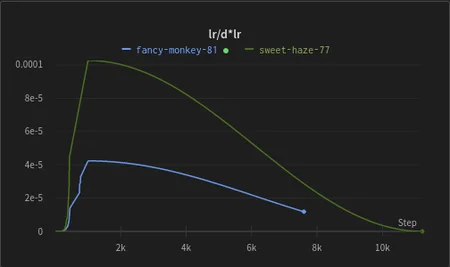
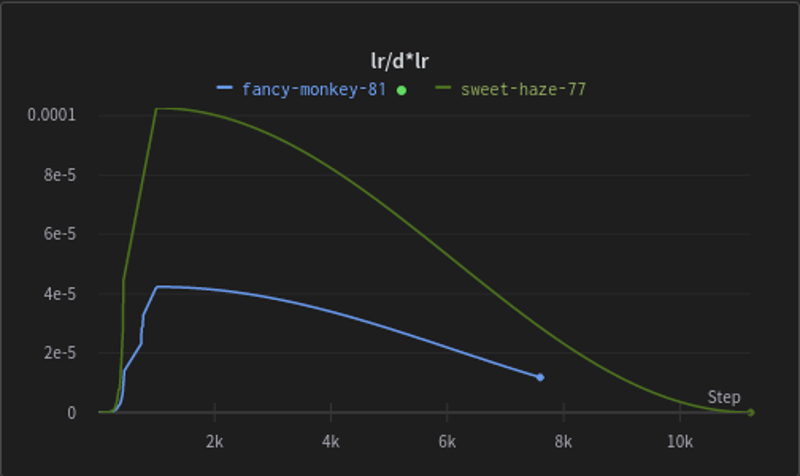
Here is an example of the shift in learning rates between DAdapt V2 (green) and DAdapt V3 (blue) - in general, it's less heavy in blasting out a higher learning rate and cooking the image faster, meaning we can keep the weight decay lower than previously practiced:
DAdaptation removes the need for setting restarts, setting learning rates, text encoders, unet learning rates etc. Simply put, you can flick a switch and it will generate your LoRA with minimal effort.
DAdapt can be used for all LoRAs. Characters, concepts, artist, style etc.
DAdapt needs a higher 'weight decay' value, as expressed in the research data and the LoRA results. This is the primary method for tweaking your LoRA. Is your LoRA not learning enough before it overfits? Increase the weight decay in .1 increments. With the release of V3, it seems to blast the learning rate a lot less heavily than V1.5 or 2, and so we can usually get away with reducing the weight decay more than we used to for the previous interations of the optimizer.
DAdapt should have the learning rate, text encoder and unet learning rate set anywhere from 0.5 to 1. This is personal preference, but I've found keeping it at '1' and tweaking the weight decay is the simplest method of fine-tuning training.
DAdapt needs the argument --optimizer_args "decouple=True" setting along with the weight decay settings (for example): "weight_decay=0.4" "betas=0.9,0.99"
This can be done in the Bmaltais Kohya GUI through the parameters boxes.
Here are a few of the settings I have confirmed work well:
Learning Rate (LR) 1
Text Encoder (TE) 1
UNET 1
Weight Decay (WD) - From 0.2-1 - will require longer training to learn more, but FAR less prone to overfitting
Repeats 1 for each data subfolder - Allows for tweaking of steps via epochs and removes the need to do math
Resolution 512 - DAdapt is a heavier train and needs better hardware. 768 is not worth it
Clip Skip 2 - For NAI based models
Training Model NAI
Scheduler Cosine - Constant is not good, and I'm not sure why it was originally recommended for DAdaptation
Batch Size - As high as you can go for your hardware. For example, 6 for a 3060 - From my experience it's better to set this and forget it, and focus on more impactful settings for training
Epochs - Set it as high as you want. As an example, I have tested a 36 image, 3 character LoRA. This started to burn out at around 230 epochs at weight decay 0.4 totalling around 2400 steps at batch 6 - Once again, DAdapt needs more steps to achieve results as we're actively hampering the learning through decay
DIM32 - (or set it lower to '8' for example, increase training time/reduce weight decay)
Alpha16 - (match the DIM if set to 8 or lower)
Warmups - Relatively untested, but I just set it to 0.1 to give it a bit of time to calibrate (?) - set warmups to 0 if you're using the above .json and the "growth_rate=1.02\" argument
How many training steps for my LoRA? - Final steps are divisible by your batch - for example, at batch 6, for a single character LoRA on DAdaptation I would probably expect anywhere from 600-1200 steps. Generally, training til overfitting and going back down the epochs will save needing to re-train the LoRA all over again with new settings
Examples:
XYZ plot starting at 100 epochs, up to 234 - 1/1/1 TE/UNET/LR, 0.4 weight decay, 0.1 warmup steps - training at batch 6 totalling around 2,400 steps
Note that these are trained on a tiny dataset of 12 images per character with one outfit, and should not be a representation of the plability of character clothing, positions etc.

LoRA trained on 3 characters, example tags:
Aru - Aru, long hair, breasts, bangs, shirt, gloves, ribbon, yellow eyes, white shirt, pink hair, horns, collard shirt, red ribbon, coat, blunt bangs, fur-trimmed coat, halo
Shiroko - Shiroko, long hair, breasts, bangs, blue eyes, animal ears, animal ear fluff, mismatched pupils, cross hair ornament, blue scarf, grey hair, halo
Karin (Bunny) - Karin, large breasts, black hair, halo, animal ears, cleavage, hair between eyes, fake animal hears, playboy bunny, rabbit tail, yellow eyes, very long hair, dark skin
(The final epoch version has been uploaded to this Civitai post)
Example .safetensors -
Final Epoch - https://files.catbox.moe/muah1o.safetensors
200 - https://files.catbox.moe/luvylf.safetensors
180 - https://files.catbox.moe/xkemzm.safetensors
160 - https://files.catbox.moe/ane6p6.safetensors
140 - https://files.catbox.moe/frshlg.safetensors
120 - https://files.catbox.moe/47hsmp.safetensors
100 - https://files.catbox.moe/qgbxs9.safetensors
Description
FAQ
Comments (16)
Thanks for the interesting information!LoRA is very complicated and I am always struggling with the best settings. I will try this method tonight!
Have you tested DAdaptation with mini snr gamma?
I'm sorry if this is a stupid question, I'm still trying to learn more about LORAs.
Could you explain this line:
Scheduler - Cosine - Constant is not good, and I'm not sure why it was originally recommended for DAdaptation
I thought the idea of constant scheduler + DADAPTATION is that with an adaptive learning rate, having constant learning will allow you to train your LORA with less steps/epochs since it's learning with every step/epoch. With cosine, wont LORA be learning nothing during the period where cosine makes LR close to 0?
Could you also explain what situations would call for a LORA vs LOCON vs LOHA? What settings should be used for each situation?
Thank you for making such a straightforward guide! I'm giving it a try right now.
thank u for testing!
i am sdbds ,whic implement DA V3 for kohya_ss.
i have some suggestion about optimizer_args
for DAV3 except WD.
new DAdaptAdam has a new optimizer_args
called
use_bias_correctionit is useful and default for off
most DAdapt have
growth_rateexcept DAdaptLion
it is optimizer's warmup speed
we can just use it instead of warmup in kohya_ss
May be a silly question, but or the settings in this guide correct? Unless I set the repeats super low, I end up with steps in the 100,000s. I also noticed that although you talk about having 200 epochs, there's a setting in the config file that sets the epochs at 50.
I usually train from 50 to 100 images, how much steps you would recomend with this method, supposing 1 repeat 1 batch size? Currently I’m using 10 repetitions per image, and usually got bad results between 6th and 7th epoch
Other question, what is the option in Kohya GUI, to save the training state, and at the same time, to resuming training again?
Do you think is better idea to use cosine with restarts or just stay with cosine? I didn't know adaptation also regulates the restarts that's interesting. I also haven't used the data from the graph loss and I think I need learn that, is that generated at the end of every epoch?
Thanks for the guide. How do I work out the total steps? I thought it was something like: images x repeats x epochs / batch size, but for some reason, the total steps is always different from the ones I calculate.
For example, I have 37 images, 1 repeat, 200 epochs (saving every 10 epochs) and 6 batch size should be 1,233~, but in the console, it says it's 2400 and is going to take over 2 hours. I don't really care about the time, but I'd like to know why it's giving me a different final step count than what I calculated.
I have --min_bucket_reso 320 --max_bucket_reso 1024 --max_train_epochs="200" in the additional parameters and "decouple=True" "betas=0.9,0.99" "use_bias_correction=True" "growth_rate=1.02" in the optimizer extra arguments
Is this a bug or am I just missing something?
I followed the guide word by word from Rentry, even used the json save provided, and when I hit training, instead of doing 200 epochs it simply does 50 in total, and I have no idea why, console says the command I sent was for 200 and it says there will be a total of 50
What settings would you recommend for a concept lora? Around 100 images.
Thank you so much! This worked like magic!
hi,
is it recommended to use this method along with regularisation images?
I used the provided json on a dataset of 111 images and it now takes 16 hours… which is fine for me… but it still has 4 hours too go and sample images have been overlooked for the last couple hours. What is the best approach now? Like, if I start all over with the same dataset, what settings should I change? Thx in advance
Q: what is the fight about "Prodigy is all you need" versus DAdaptation? https://civitai.com/articles/1022/update-sdxl-scriptbdsqlsz-lora-training-advanced-tutorial2prodigy-is-all-you-need
I trained one lora (smirking facial expression) with the settings recommended in this guide, let it run for a long time and cherrypicked one of the subversions. When I compared the result with a lora trained with my usual settings (not using fancy optimizers at all) the differences were very small, and I genuinely can't say which is better. I don't think the added running time from DAdapt is worth it.
does this work for realistic face LoRA? also, i'm not sure what you mean by a "guide" since there appears only to be a list of parameters. In my experience, if i input any parameter into kohya it 99% of the time going to result in a non-zero exit status 1 before anything gets trained. this guide is for kohya right?