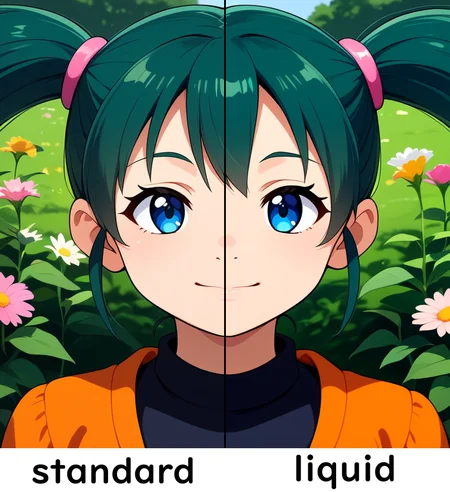
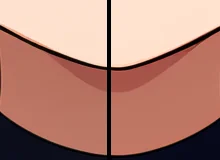
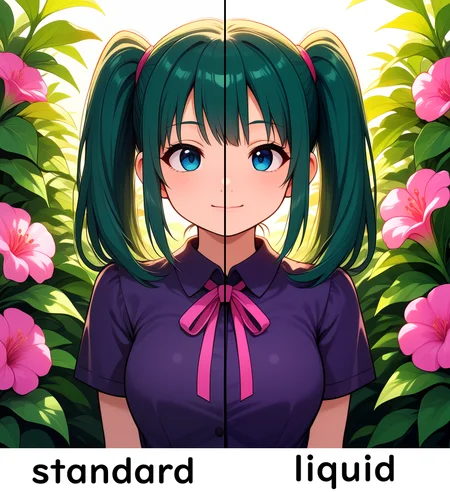
This merged VAE improves anime-style shading by refining the color balance and reducing visible gaps between lineart and fill colors.
The merge also suppresses the white fringe that can appear between dark outlines and flat color areas, resulting in cleaner edges and more stable rendering.
Highlights keep a slight cool tint while shadows remain warm, producing smoother gradients and cleaner soft warm tones commonly used in stylized anime rendering.
As a trade-off, pink tones may appear slightly stronger in some situations, especially with warm lighting or high saturation.
This behavior helps avoid muddy gradients, but it may not fit all styles.
This VAE was tested with Qwen-based image models, but it is also compatible with Anima-based models that use the same VAE format, and can be used as a drop-in replacement in most Anima workflows.
from PIL import ImageEnhance

PALE_ORANGE = (238, 196, 172)
LIGHT_BROWN = (198, 122, 96)
DARK_BROWN  = (110, 58, 42)
PURE_BLACK  = (18, 18, 18)


def clamp8(x):
    return max(0, min(255, int(round(x))))


def lerp(a, b, t):
    return a + (b - a) * t


def smoothstep(edge0, edge1, x):
    if edge0 == edge1:
        return 1.0 if x >= edge1 else 0.0
    t = (x - edge0) / (edge1 - edge0)
    t = max(0.0, min(1.0, t))
    return t * t * (3.0 - 2.0 * t)


def apply_gamma_u8(v, gamma):
    x = max(0.0, min(1.0, v / 255.0))
    return clamp8(255.0 * (x ** gamma))


def dist3(r1, g1, b1, r2, g2, b2):
    dr = r1 - r2
    dg = g1 - g2
    db = b1 - b2
    return dr * dr + dg * dg + db * db


def snap_to_palette(rr, gg, bb, palette, strength=1.0):

    best = None
    best_d = None

    for pr, pg, pb in palette:
        d = dist3(rr, gg, bb, pr, pg, pb)
        if best_d is None or d < best_d:
            best_d = d
            best = (pr, pg, pb)

    pr, pg, pb = best

    rr = lerp(rr, pr, strength)
    gg = lerp(gg, pg, strength)
    bb = lerp(bb, pb, strength)

    return rr, gg, bb


def preprocess_anime_color(img):

    img = ImageEnhance.Brightness(img).enhance(1.10)
    img = ImageEnhance.Color(img).enhance(1.04)
    img = ImageEnhance.Contrast(img).enhance(1.04)

    r, g, b = img.split()

    r = r.point(lambda x: clamp8(x * 1.07))
    g = g.point(lambda x: clamp8(x * 1.04))
    b = b.point(lambda x: clamp8(x * 0.98))

    img = img.merge("RGB", (r, g, b))

    px = img.load()
    w, h = img.size

    for y in range(h):
        for x in range(w):

            rr, gg, bb = px[x, y]

            lum = (rr + gg + bb) / 3
            maxc = max(rr, gg, bb)
            minc = min(rr, gg, bb)
            sat = maxc - minc
            avg = (rr + gg + bb) / 3

            warm = rr > gg > bb

            # shadow S curve
            shadow_w = 1.0 - smoothstep(70, 115, lum)

            if shadow_w > 0:

                factor = (max(lum, 1) / 100.0) ** 1.2

                rr = lerp(rr, rr * factor, shadow_w)
                gg = lerp(gg, gg * factor, shadow_w)
                bb = lerp(bb, bb * factor, shadow_w)

            # mid tone fix
            midgray_w = smoothstep(75, 95, lum) * (1.0 - smoothstep(120, 140, lum))
            low_sat_w = 1.0 - smoothstep(65, 90, sat)

            fix_w = midgray_w * low_sat_w

            if fix_w > 0:

                rr = lerp(rr, avg + (rr - avg) * 0.85, fix_w)
                gg = lerp(gg, avg + (gg - avg) * 0.85, fix_w)
                bb = lerp(bb, avg + (bb - avg) * 0.75, fix_w)

            # lift shadow
            shadow_lift_w = smoothstep(90, 105, lum) * (1.0 - smoothstep(135, 150, lum))

            if shadow_lift_w > 0:

                rr = lerp(rr, rr * 1.04 + 4, shadow_lift_w)
                gg = lerp(gg, gg * 1.04 + 4, shadow_lift_w)
                bb = lerp(bb, bb * 1.04 + 4, shadow_lift_w)

            # gamma skin
            midtone_w = smoothstep(70, 95, lum) * (1.0 - smoothstep(170, 195, lum))

            if midtone_w > 0:

                rr_gamma = apply_gamma_u8(rr, 0.95)
                rr = lerp(rr, rr_gamma, midtone_w)

            # highlight transparency

            if warm:

                bright_w = smoothstep(125, 145, lum)
                highlight_w = smoothstep(205, 225, lum)

                if bright_w > 0:

                    rr = lerp(rr, rr * 1.04, bright_w)
                    gg = lerp(gg, gg * 1.03, bright_w)
                    bb = lerp(bb, bb * 0.94, bright_w)

                if highlight_w > 0:

                    rr = lerp(rr, rr * 1.02, highlight_w)
                    bb = lerp(bb, bb * 1.05, highlight_w)

            # pink fringe fix

            fringe_w = 1.0 - smoothstep(10, 22, sat)

            if fringe_w > 0:

                gray = avg

                rr = lerp(rr, gray, fringe_w * 0.9)
                gg = lerp(gg, gray, fringe_w * 0.9)
                bb = lerp(bb, gray, fringe_w * 0.9)

            # boundary cleanup

            boundary_w = smoothstep(55, 105, lum) * (1.0 - smoothstep(150, 185, lum))
            pinkish_w = smoothstep(8, 22, rr - gg) * (1.0 - smoothstep(28, 55, gg - bb))

            fix_boundary = boundary_w * pinkish_w

            if fix_boundary > 0:

                rr = lerp(rr, rr * 0.96, fix_boundary)
                gg = lerp(gg, gg * 1.01, fix_boundary)
                bb = lerp(bb, bb * 0.90, fix_boundary)

            # palette snap

            warm_skin_like = rr > gg > bb

            if warm_skin_like:

                if lum > 170:
                    pal = [PALE_ORANGE, LIGHT_BROWN]
                    s = 0.7
                elif lum > 95:
                    pal = [LIGHT_BROWN, DARK_BROWN]
                    s = 0.8
                else:
                    pal = [DARK_BROWN, PURE_BLACK]
                    s = 0.85

                rr, gg, bb = snap_to_palette(rr, gg, bb, pal, s)

            px[x, y] = (
                clamp8(rr),
                clamp8(gg),
                clamp8(bb),
            )

    return img
Description
FAQ
Comments (4)
I haven't played with image generators a while, but I found out with SDXL models with a custom VAE and some weird setup you can get native transparent output. Could you by chance fine-tune something to do this? Getting line art that is transparent out of it so I can practice art would be neat
Yeah, that’s probably LayerDiffuse / latent transparency.
There’s a 2024 paper called
"Transparent Image Layer Diffusion using Latent Transparency"
https://arxiv.org/abs/2402.17113
That shows you can fine-tune a latent diffusion model (like SDXL) to generate RGBA natively.
It’s not really just a custom VAE — it uses a modified decoder and encodes alpha in the latent space.
In theory you could fine-tune a model to do this, but it’s not a simple LoRA-style finetune.
The original method used a large RGBA dataset and special training.
If you just want transparent output, using LayerDiffuse is much easier than training your own.
Transparent line art works, but you’ll probably still need some cleanup depending on the model.
This somewhat fixes the half-tone texture I've been getting with Anima gens. Thank you!
this is good stuff.