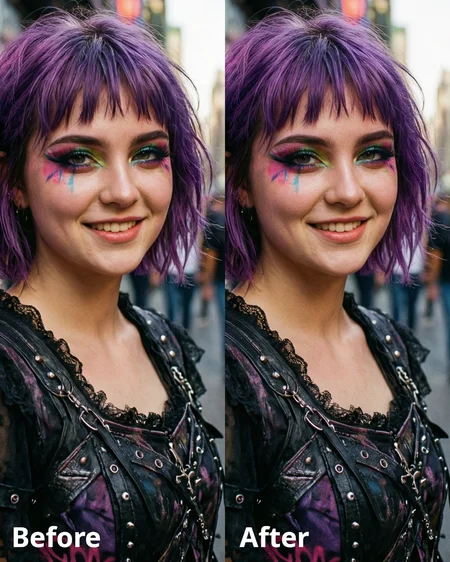
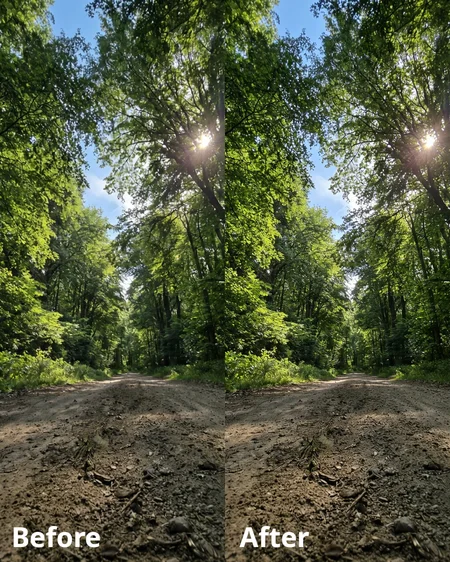
This is an experimental instruction-edit LoRA for Flux.2 Klein intended to improve the visual quality of images that were produced by the Qwen-Image VAE decoder (i.e. any image made with any version of Qwen-Image and Qwen-Image-Edit, or Krea 2, etc. using the default VAE).
Qwen-Image's VAE produces noticeably washed out details and a checkerboard noise pattern. By leveraging the Flux.2 VAE, which is able to produce higher-fidelity images, these issues can be fixed to some extent.
I would recommend starting with cfg at 1.0 as a baseline. Pushing cfg past 3.0 seems to result in an increasing amount of artifacts.
❗ This is not intended to be a general purpose detailer. It expects input images with typical Qwen-Image VAE artifacts and may produce poor results on other images. This includes images generated with Qwen-Image models using e.g. the Wan2.1 upscale2x VAE instead of the default VAE. ❗
Training
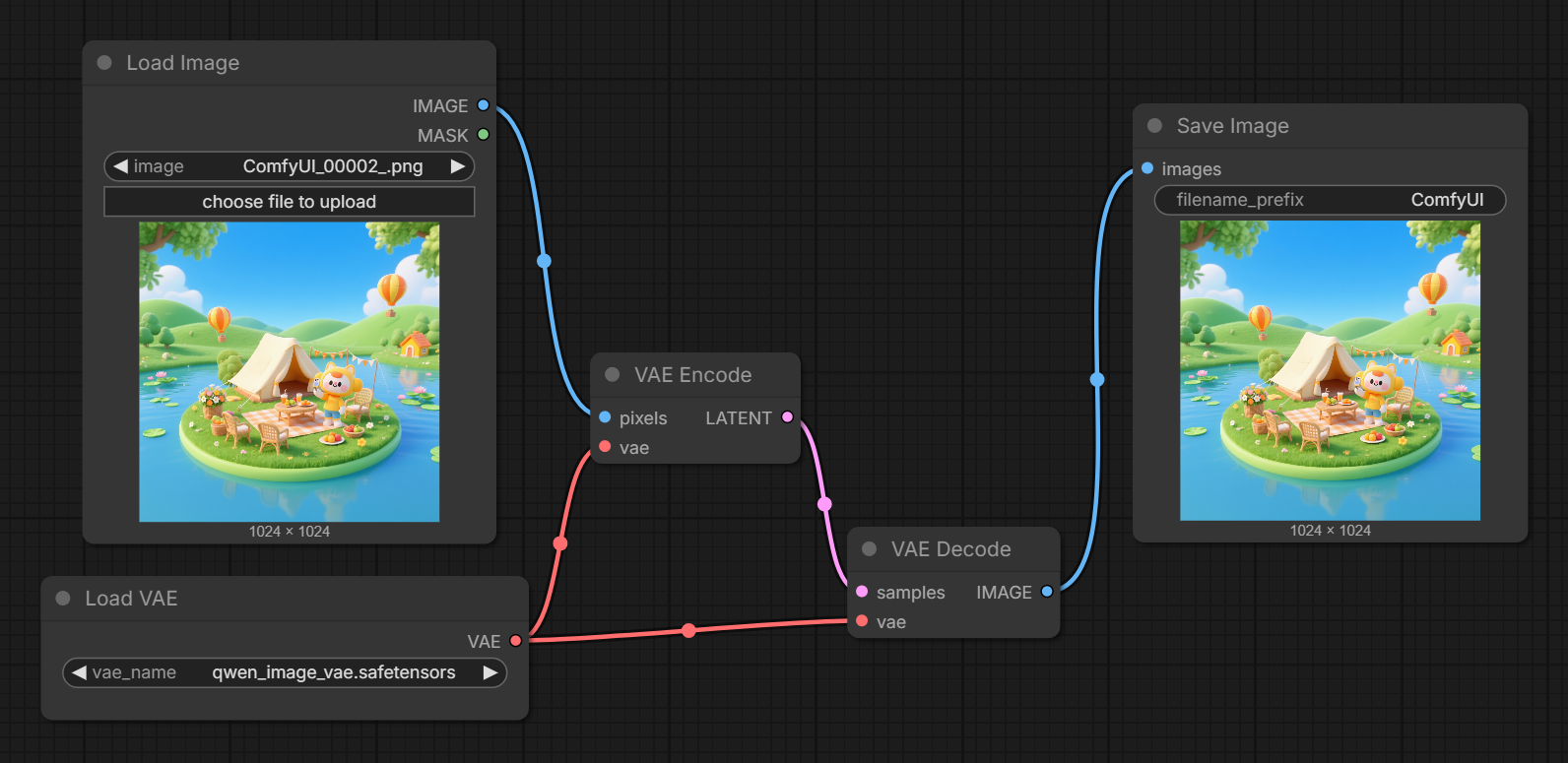
The LoRA was trained on a selection of 1024x1024 photos before and after being encoded and decoded with the Qwen-Image VAE with no changes made to the latent as illustrated in this workflow:
Version 1.0 was trained on a dataset of 23 image pairs, mostly focused on skin, faces/hair, and vegetation. There is likely room for improvement with a more diverse dataset, but it's hard to say how much.
Description
FAQ
Comments (4)
Such a cool idea! What is the recommended LoRA strength? Also, it says that the LoRA is for the Base version of Klein.2 9B, but that version should be used with CFG>1.0. Using un-distilled models at CFG of 1.0 normally produces garbled images.
Sorry, I forgot to add the strength recommendation. I only ever tested it with a strength value of 1.0, which seems to work fine.
I always stick to a LoRA strength of 1.0 (or very close to it) for instruction-edit LoRAs because the base model often has no idea what the instructions mean and the combined effects can be unpredictable.
As for the cfg value, I haven't observed any garbled images in my tests at cfg=1.0 (on 9B Base), neither with this LoRA nor any of my other edit LoRAs. At worst, the edit effect will be lackluster at cfg=1.0 and you need to bump it higher for a more pronounced effect (but also a higher chance of unwanted side effects).
Wait so your comparison pictures dont really show a fair comparison what your lora can do but what Wan2.1 upscale2x VAE can do?
I didn't use the Wan2.1 upscale2x VAE at any point, either for training or for the example images.
I only mentioned the upscale2x VAE in the description text because I know it is quite popular and I meant to point out that my LoRA wasn't trained on images decoded with the upscale2x VAE and might not work well with such images.
The training data consists of image pairs where the target image is a downscaled and/or cropped photograph and the control image is that same target image after being passed through the workflow shown in the screenshot in the description (Load Image -> VAE Encode -> VAE Decode -> Save Image, using the regular Qwen-Image VAE), which ends up degrading the quality.
The "Before" images in the comparison were generated with Qwen-Image-Edit 2512 and the default VAE. The "After" images were generated with Flux.2 Klein 9B Base, this LoRA, and of course the Flux.2 VAE.