
Flux.2
FLUX 2.0 Is Finally Here
FLUX.2 is built for real creative production, not just eye-catching demos. It delivers high-quality visuals with consistent characters and styles across multiple references, follows structured prompts accurately, handles complex text, respects brand guidelines, and manages lighting, layout, and logos with reliability. It can also perform image editing at resolutions up to 4 megapixels while preserving clarity and coherence.
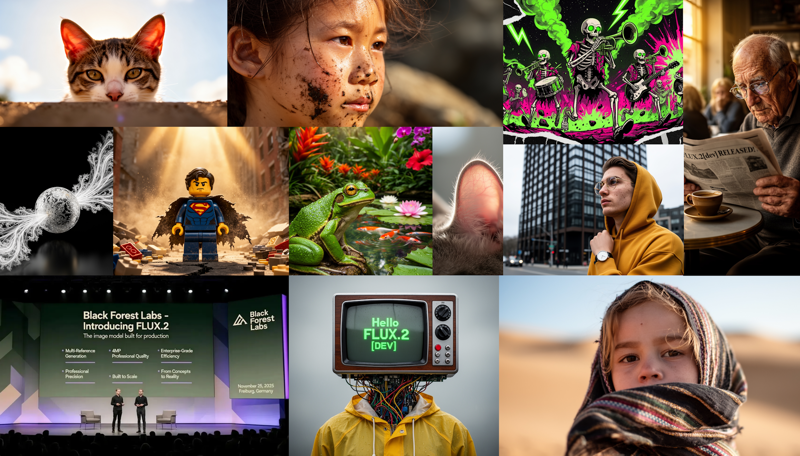
Black Forest Labs: Open Core
BFL Team believe visual intelligence should be developed collaboratively by researchers, creators, and developers everywhere—not concentrated in a few hands. That’s why they pair cutting-edge performance with open research and open innovation. Alongside scalable, customizable production endpoints, we release powerful, transparent, and modular open-weight models for the community.
When a team founded Black Forest Labs in 2024, their mission was to make open innovation sustainable, building on their history of delivering some of the world’s most widely used open models. Team combined open systems like FLUX.1 [dev]—now the most popular open-image model worldwide—with professional-grade variants like FLUX.1 Kontext [pro], used by teams from Adobe to Meta. This open-core philosophy fuels experimentation, invites scrutiny, lowers costs, and allows devs to continue sharing open technology from both the Black Forest and the Bay with the world.
From FLUX.1 to FLUX.2
Where FLUX.1 demonstrated how powerful media models can be as creative tools—delivering precision, efficiency, control, and realism—FLUX.2 shows how frontier-level capability can reshape full production pipelines. By dramatically improving the economics of generation, FLUX.2 is positioned to become a foundational component of modern creative workflows.
What’s New
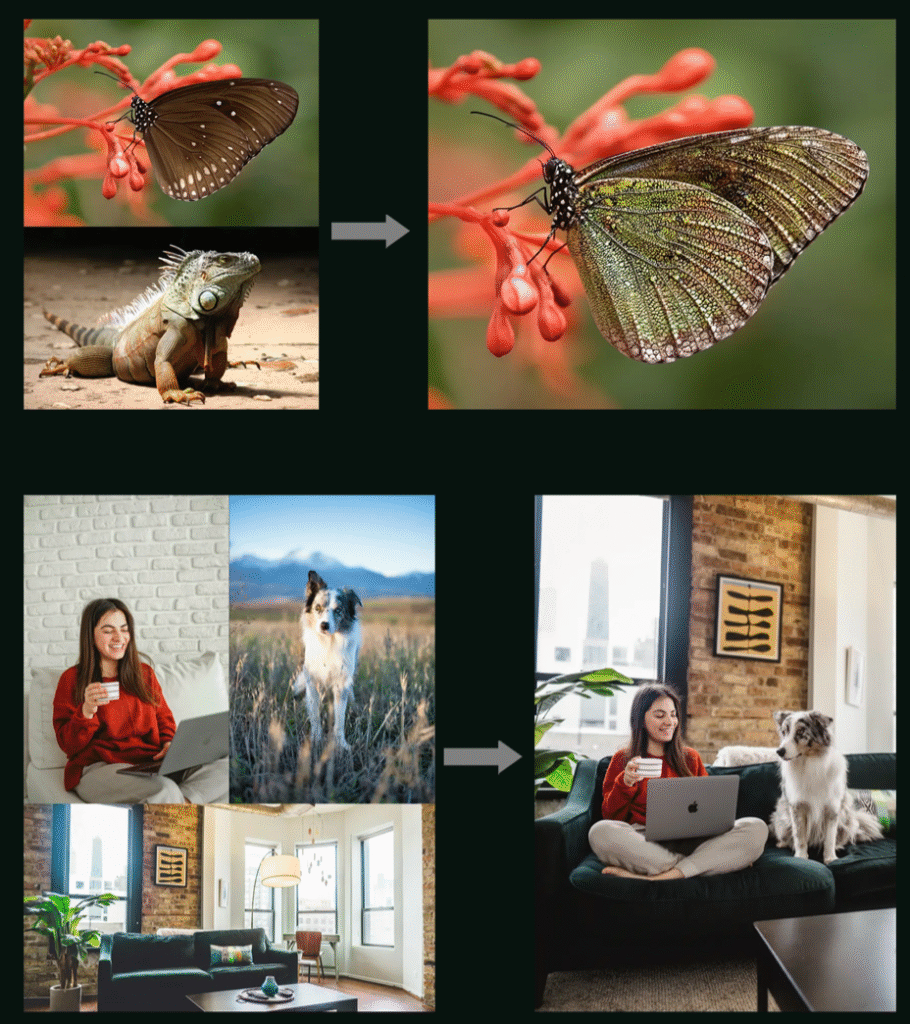
Multi-Reference Generation
Use up to 10 reference images at once and achieve industry-leading consistency in characters, products, and visual style.
Improved Detail & Photorealism
Sharper textures, more precise detailing, and stable, realistic lighting make it ideal for product imagery, visualization, and photography-grade outputs.
Advanced Text Rendering
Typography, infographics, memes, and UI mockups now generate with reliably clear, readable fine text suitable for production use.
Stronger Prompt Obedience
The model follows complex, multi-section prompts and compositional rules more accurately than before.
Expanded World Knowledge
A deeper understanding of real-world context, lighting, physics, and spatial relationships leads to scenes that behave and look the way you’d expect.
Higher Resolution & More Flexible I/O
Supports image editing at resolutions up to 4 megapixels, with greater freedom in aspect ratios and input/output formats.
Editing: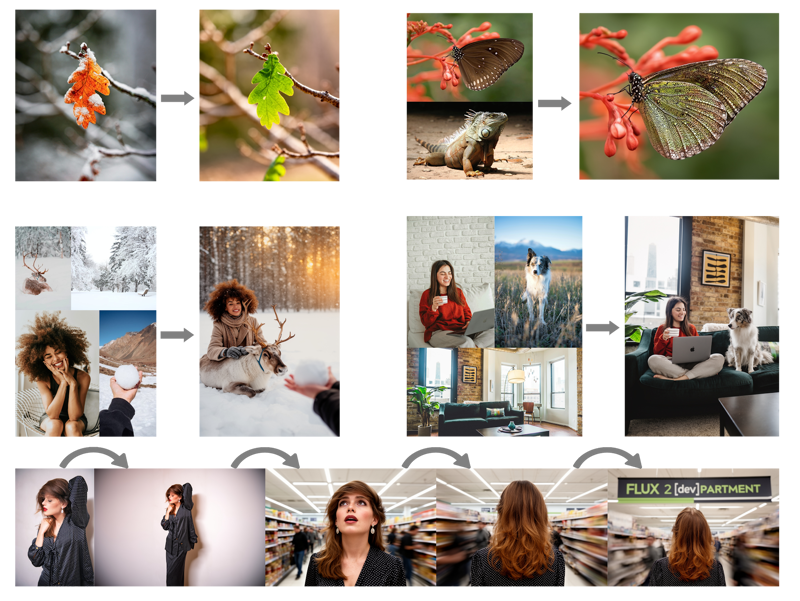
FLUX.2 [dev]
A 32B open-weight model derived from the core FLUX.2 architecture. It is the most capable open-weight model for image generation and editing available today, offering text-to-image and multi-image editing within a single checkpoint. The weights are published on Hugging Face and can be executed locally using our reference inference code. With consumer-grade GPUs (such as GeForce RTX), you can run an optimized fp8 implementation built with NVIDIA and ComfyUI.
You can also sample FLUX.2 [dev] through API endpoints on FAL, Replicate, Runware, Verda, TogetherAI, Cloudflare, and DeepInfra.
For commercial licensing, visit our website.
Source: https://flux2.io/flux-2-0-is-finally-here/
FLUX.2 – VAE
A newly engineered variational autoencoder providing a balanced blend of learnability, compression efficiency, and output quality. It underpins all FLUX.2 flow backbones. A detailed technical write-up is available, and the FLUX.2 VAE is released on Hugging Face under the Apache 2.0 license.
Description
FAQ
Comments (10)
So, FLUX.2 > Qwen Image Edit?
Oh, I see now. Almost the same level. -_- Can't keep the face consistent, image shift same as qwen's...
Last hopes on z image edit upcoming.
@forfreelsd368 That's odd. For me there's no image shift in ~90% of cases, and in the rest there's just a very minor shift. If you use the ReferenceLatent node and if you set your final image dimensions to be multiples of 16, you shouldn't really get any shifting.
And yes, Flux.2 is much more advanced than Qwen Image Edit. Not sure how you came to the conclusion that they are almost on the same level. With Flux.2 you can use more references. It has much better image quality due to its advanced 32-channel VAE, while Qwen Image Edit images often look like they have JPEG compression artifacts and pretty much no texture (textures look smudged). Qwen also has that nasty halftone pattern over the whole image (thankfully fixable with this). Subject and object consistency is also better with Flux.2 in my tests. Only downside is it's not fully open-source and it's heavier to run due to having much more parameters and larger text encoder. 64GB RAM and 24GB VRAM is pretty much the minimum to be able to use the model and text encoder in FP8 precision. Image quality however is night and day difference compared to Qwen and any other local model I've used. The skin rendering is absolutely fantastic and indistinguishable from real life in my tests. Nothing like the plastic Qwen and Flux.1 skin. Hopefully the Klein version of Flux.2 drops soon and it strikes a good balance of hardware requirements while preserving most of the image quality of the Dev version.
@mmdd2543 I agree, ifind FLUX2 better with hair and skin consistency. QwenEdit even without lightning lora makes it plastic.
Hello, the text_encoders you shared are the abrided version marked "small" made by ComfyUI, not the complete version of text_encoders from the studio!
So, is it Flux 2 or Z-image ?
Flux 2 is too heavy and too slow. Zit is a better option.👍🏻
not for image edit function. this is current king. will circle back once Zimage edit comes out
OMG, even more censored ver of Flux is here
What is the difference between your Q6_K at 21gb vs the city96 Q6_K at 26gb? https://huggingface.co/city96/FLUX.2-dev-gguf
Details
Files
flux2_encoderFP16.safetensors
Mirrors
mistral_3_small_flux2_bf16.safetensors
mistral_3_small_flux2_bf16.safetensors
mistral_3_small_flux2_bf16.safetensors
mistral_3_small_flux2_bf16.safetensors
mistral_3_small_flux2_bf16.safetensors
Mistral 3 Small [BF16].safetensors
mistral_3_small_flux2_bf16.safetensors
mistral_3_small_flux_bf16.safetensors
mistral_3_small_flux2_bf16.safetensors
mistral_3_small_flux2_bf16.safetensors
mistral_3_small_flux2_bf16.safetensors
mistral_3_small_flux2_bf16.safetensors
mistral_3_small_flux2_bf16.safetensors
mistral_3_small_flux2_bf16.safetensors
mistral_3_small_flux2_bf16.safetensors
mistral_3_small_flux2_bf16.safetensors